
Three questions every credible business can answer
Credibility comes from completeness, not brilliance
Welcome everyone!
Today we’re looking at what makes up a credible business. There is, however, a small problem in that “credible” means different things to different people. Customers, suppliers, investors, employees etc will all have slightly different take.
The Three Questions (and Pillars)
So, we’re going to look at it from the business point of view, and from this perspective to be credible, the business has to be able to answer the following 3 questions:
Why will customers buy?
Will what they buy work?
How do we deliver (colloquially, how do we pull it off)?
These three questions are a simple way of identifying the three pillars that support credible businesses.
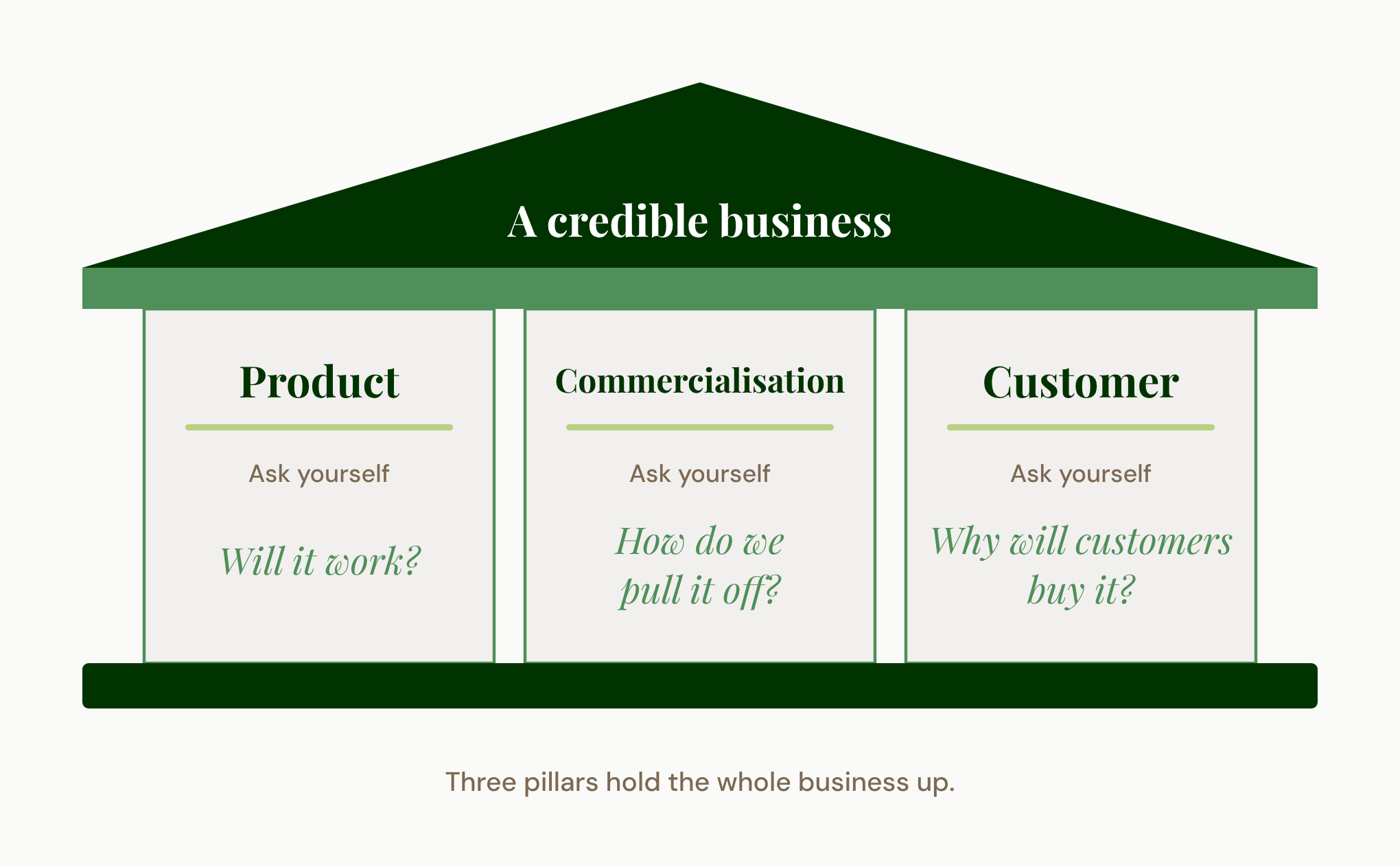
Three pillars supporting a credible business image.
Simple. Three questions, each an essential part of a pillar supporting the business. Whilst it would be great to be able to answer all three questions (and hence build your pillars) at the same time, that’s realistically not going to happen. EVER.
No, not even with AI.
Building a business from an idea
On the path to building a credible business, some of the pillars are going to progress faster than others. Typically, that will be the pillar that you have the most fun doing. So while you will be building one pillar REALLY well, you’re essentially relying on critical assumptions that you think are true as the basis for the other pillars.
Because you’re time limited, it’s HIGHLY unlikely that you can progress all three to the same level of confidence - after all, you actually have to get something to market before competitors do or, today, before AI or new legislation changes that market completely.
In the real world, the pillars are actually interconnected. So, having the best technical solution isn’t going to help if the customer doesn’t want it. What the customer needs may be impossible to design, or prohibitively expensive to build. Assuming that your critical assumptions (note we said critical, not all) are correct is an easy way to waste a lot of time and money.
The diagram below shows some example dependencies. The obvious one : you build something customers don’t care about.
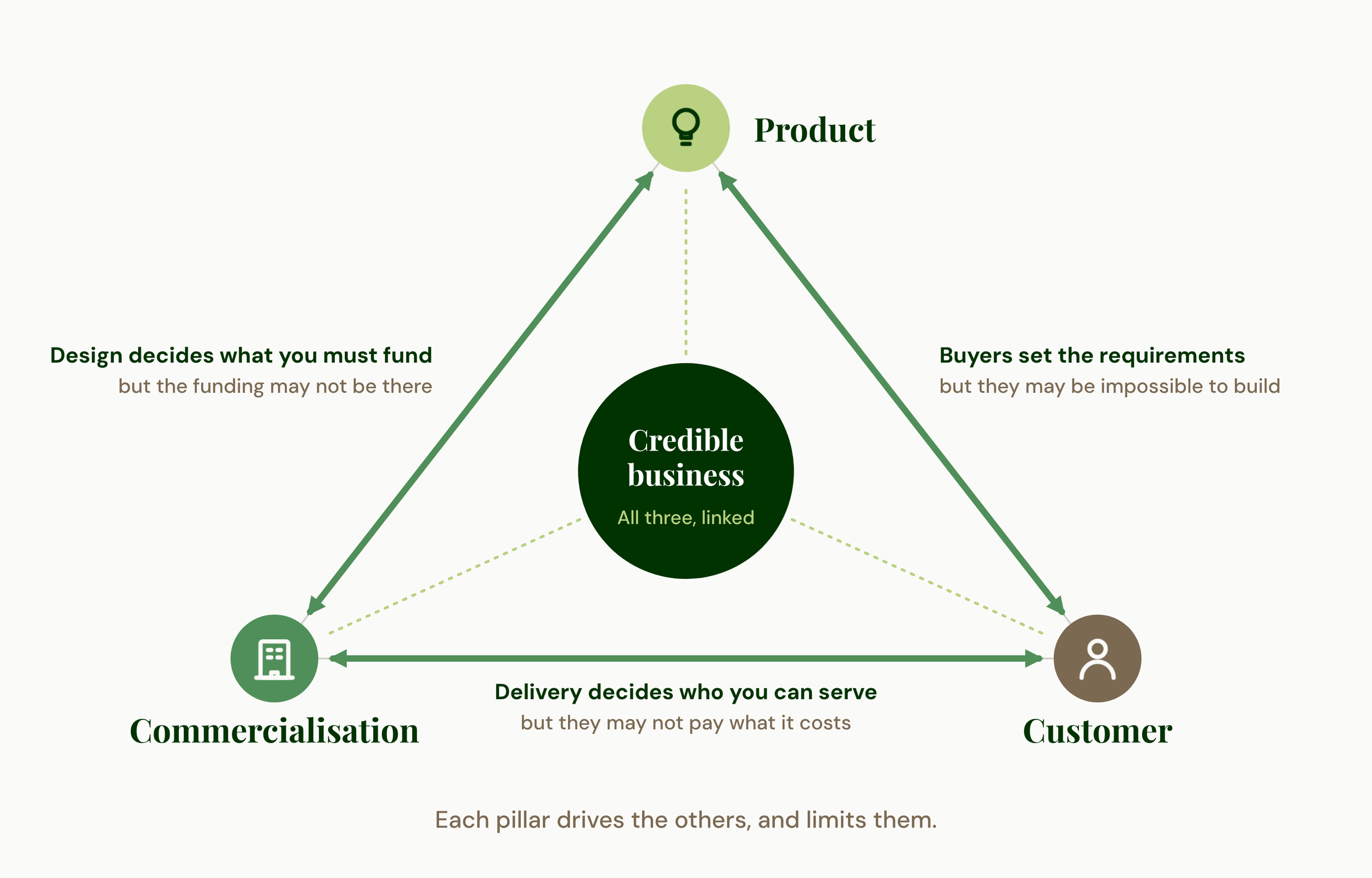
Triangle showing the links and example dependencies between three business pillars.
The key message? Don’t ignore the other two pillars that aren’t fun to do. Test the critical assumptions in each!
The three pillars - a little more detail
For each business the key sub questions to be answered in each pillar will vary. Typically, though the sub questions will be some variant of the following:
Product (Will it work?): Can we build it? Does it solve the problem? How will we prove it?
Commercialisation (How do we pull it off?): Do we have the right people? Can we make (and scale!) it? How will we fund it? Are we protecting our IP? Are we running it properly?
Customer (Why will customers buy it?): Who exactly will buy it? Is the problem painful enough to pay for? Have real buyers tested it? Is there early demand?
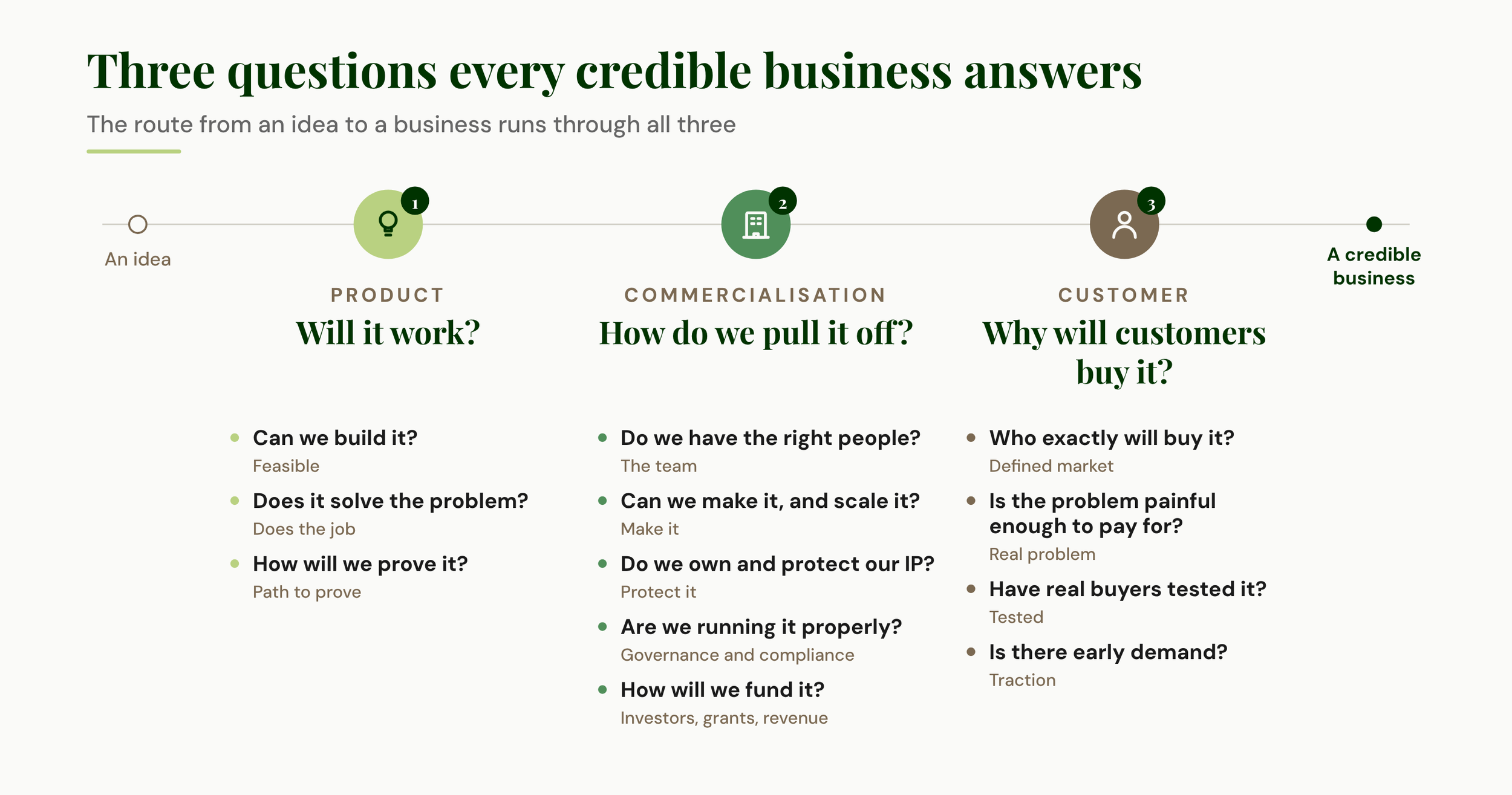
Sub-questions for each business pillar
What happens if you don’t have three pillars?
If you don’t have all three pillars, then you probably don’t have a sustainable, long term business. Note that this is true even for not for profits - the cash to support the business has to come from somewhere so whether or not profit is the objective is irrelevant. Whilst it will vary, here are some typical issues if you don’t have three pillars.
No Customer? Well, you’ve just built something that no one wants to buy. Don’t really need to explain this one.
No Commercialisation? This one is trickier, but will often come down to either production (can’t build enough of it for the price), team (can’t hold onto the expertise needed) or, most often, funding - can’t get the money to build it.
No Product? Also self explanatory.
The diagram below illustrates this, just more prettily.
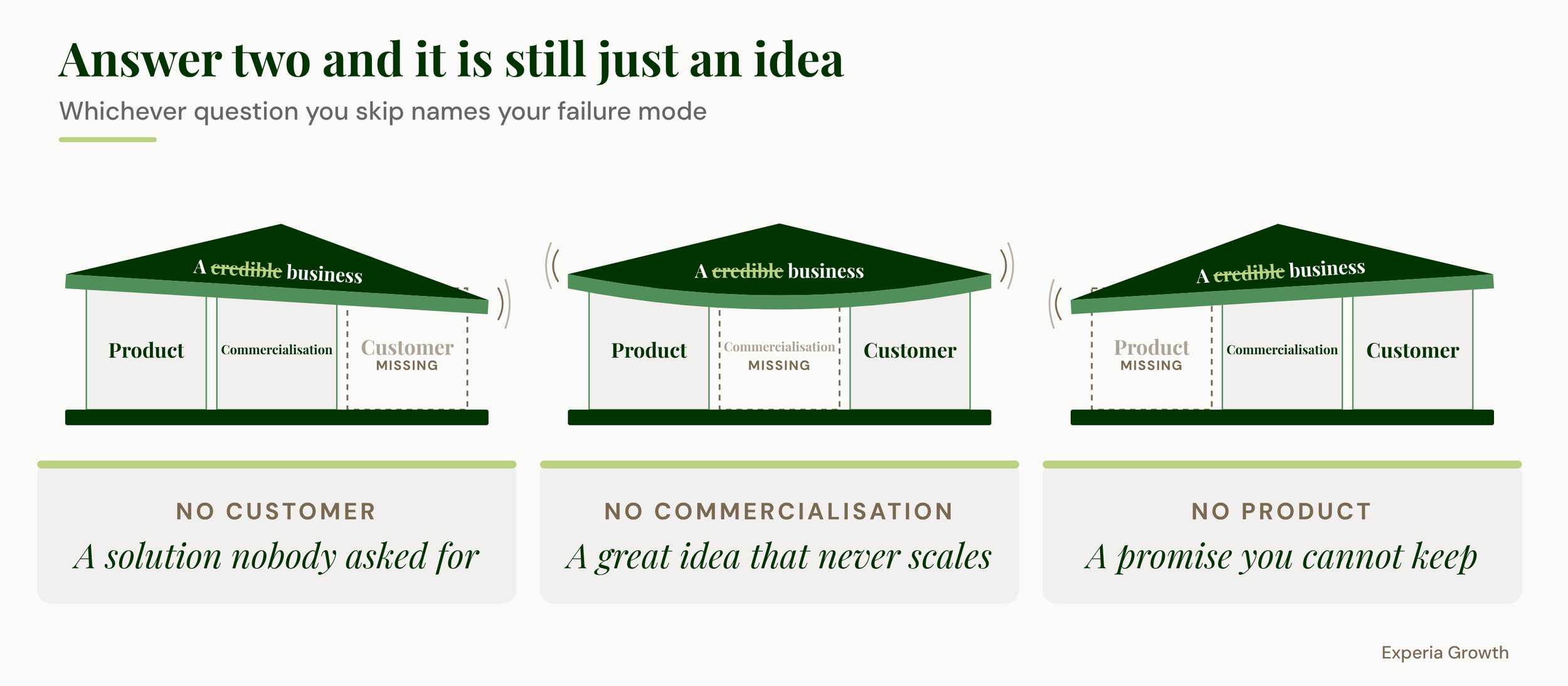
Three images showing a wobbly roof with different pillars missing.
Key Takeaways!
A business needs all three pillars in order to be credible.
Credibility comes from completeness, not brilliance. It doesn’t matter how good your product is, your marketing is or how much funding you have. If you don’t have all three, you’re not credible.
Test the CRITICAL assumptions in ALL pillars. No, not all assumptions are critical. Critical assumptions significantly affect another pillar.
Focussing on one pillar isn’t a business. It’s an idea.
**********
And that’s it for this article. As always, reach out for a coffee if you want to chat!
Until next time!