Founders! Don’t start building a business you’re going to hate!
Welcome Founders!
In this article, we’re looking at how a business can “succeed” and yet you can still hate working in it.
You know, the horror stories of Founders having severe stress, depression or generally being unhappy about the amount of time spent (waaay over the expected 4 day week!), or the startup where you have to do everything, even the things you don’t know about. The hobby business that quietly becomes and obligation. The family business no one wants. Generally, the business you created, that you just don’t want to be in.
TLDR : Founders who don’t understand their personal goals first have a very high risk of ending up in a business they hate
Why?
They thought that the business success equated to their happiness/satisfaction. i.e they didn’t understand what they really wanted or how to achieve it
They don’t set up the business to get what they want, in the time and way they want it. This is because they don’t clearly understand what the business is return for them was - money? reputation? credibility? knowledge? networks? all of these?
They’ve chosen the wrong style of business (philanthropic, hobby, family, commercial sale vs licence vs operate)
Why do Founders need to understand their goals first?
Simple. Every Founder wants something different out of life. Every Founder gets satisfaction from something different. Every Founder has different skills, passion and values. This means that every Founder wants something different from their idea and, therefore, every Founder needs to commercialise in a way that best delivers the maximum contribution to their longer term goals.
Taking the time BEFORE you create anything to pick an appropriate business style (an accordingly who your “customer” is) is comparatively inexpensive. It’s a couple of conversations. Trying to change later - that’s a loss of a lot of the effort to date, as a minimum.
Remember, your personal goal/vision probably isn’t an investable proposition. It doesn’t need to be. Your business opportunity does. A few months ago, we specifically looked at this difference from an investor lens (https://www.experiagrowth.com.au/articles/yourvisionisnotaninvestablebusiness-52026) which you can refresh on later.
In this article, we’re looking at how the Founder personal goals are fundamental to determining what you should build. Let’s get into it!
1) No single business opportunity is going to deliver all your personal goals
Your personal goals will, depending on your age, extend over a far longer period than your involvement in this business you’re looking at. It is HIGHLY unlikely that one business opportunity is going to deliver your 30 year personal financial, reputational, lifestyle etc goals.
In fact, being realistic, the failure rate for startups means that the chance of your business succeeding at all is small. Prepare for possible failure and ensure that you get what you can. This means that you need to have a realistic walk away point and your personal goals determine that.
Each business opportunity represents an asset that needs to contribute something to the achievement of at least one of your personal goals - this is the return you expect from this opportunity. You have to pick the level of effort and frustration you’re prepared to contribute/endure to get that return.
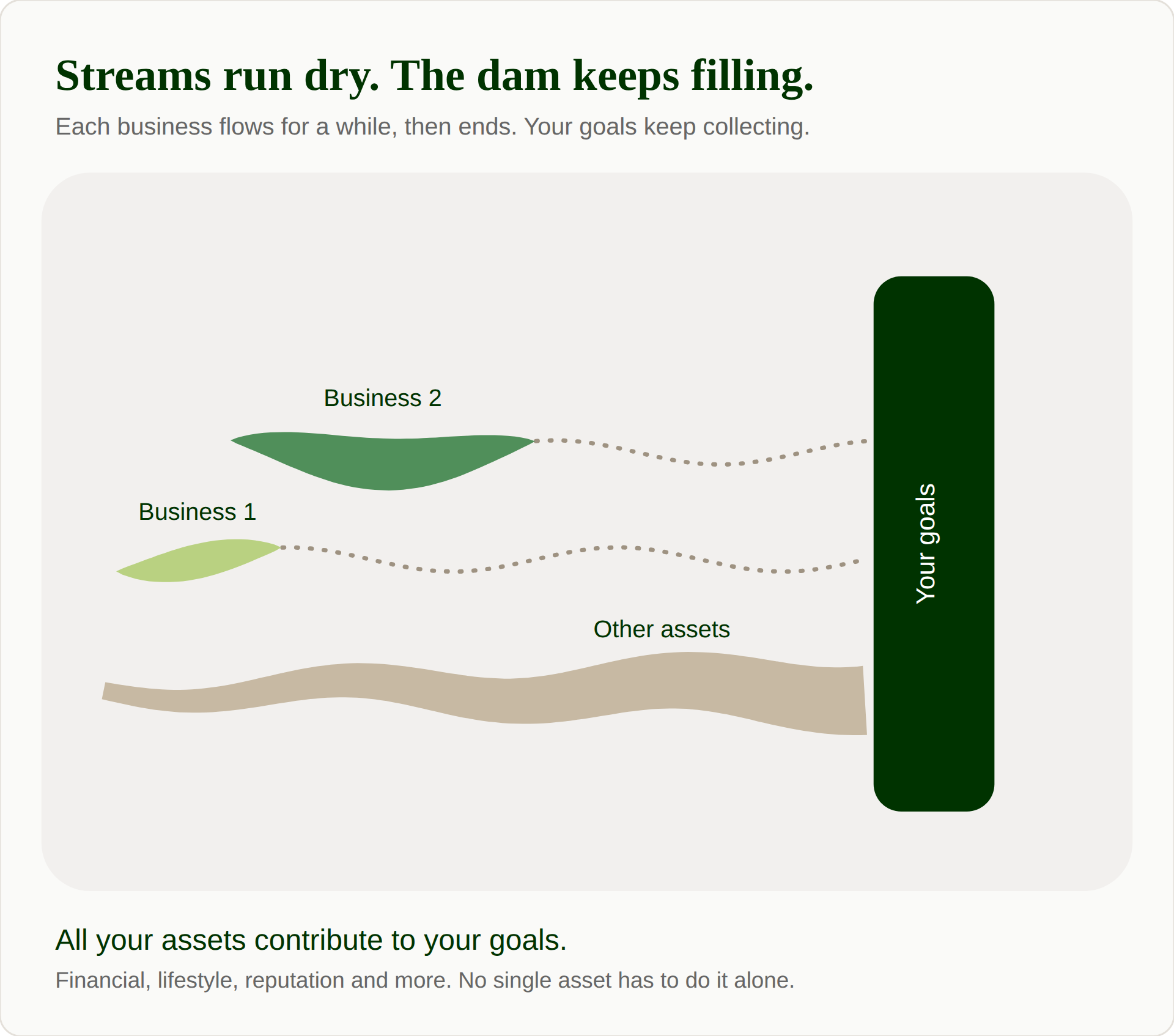
Achieving your personal goals isn’t about one business. It’s about all the businesses and all the other assets you can leverage
2) Knowing your Exit - and planning to achieve it
Yes, it is your idea. Yes, it may have the potential to be a billion dollar global business with offices in 27 countries over the next 15 years. Sure, you want to be the CEO. Oh, hang on though, if you’re a technical genius who hasn’t led a team in one country, let alone 27 that may not be realistic!
The simple fact is that you ARE going to exit this business. The only questions are a) when and b) whether it is your choice.
Understanding your goals is the ONLY way to be clear what this business opportunity is expected to contribute to your long term personal goals in return for your effort and frustration. Accordingly, it’s the only way you’re going to know whether to accept that offer, push back against a co-founder, accept that investor, hand over to someone else etc etc.
I’ve heard people say that Founders shouldn’t worry about the exit when they are setting up. Probably one of the worst things I’ve ever heard said to a Founder.
If you’re not clear what return you’re looking for, when, how do you expect to be credible when investors/co-founders/partners ask about it?
Knowing your exit is also one of the key ways of selecting the right business style in the first place.
Choosing the right business style
A business style represents the different ways a business opportunity can be commercialised. Commercialisation doesn’t mean that investors are required, or that the business is going to be a global powerhouse.
For you, commercialisation simply means turning your idea into the return you want, whatever that return is - financial, non financial, whatever.
The six most common styles are : philanthropic; hobby, family and commercial (in commercial there’s immediate sale vs licensing vs operate). Each pose a different set of requirements on a Founder and, in several cases, fundamentally change who your “customer” is.
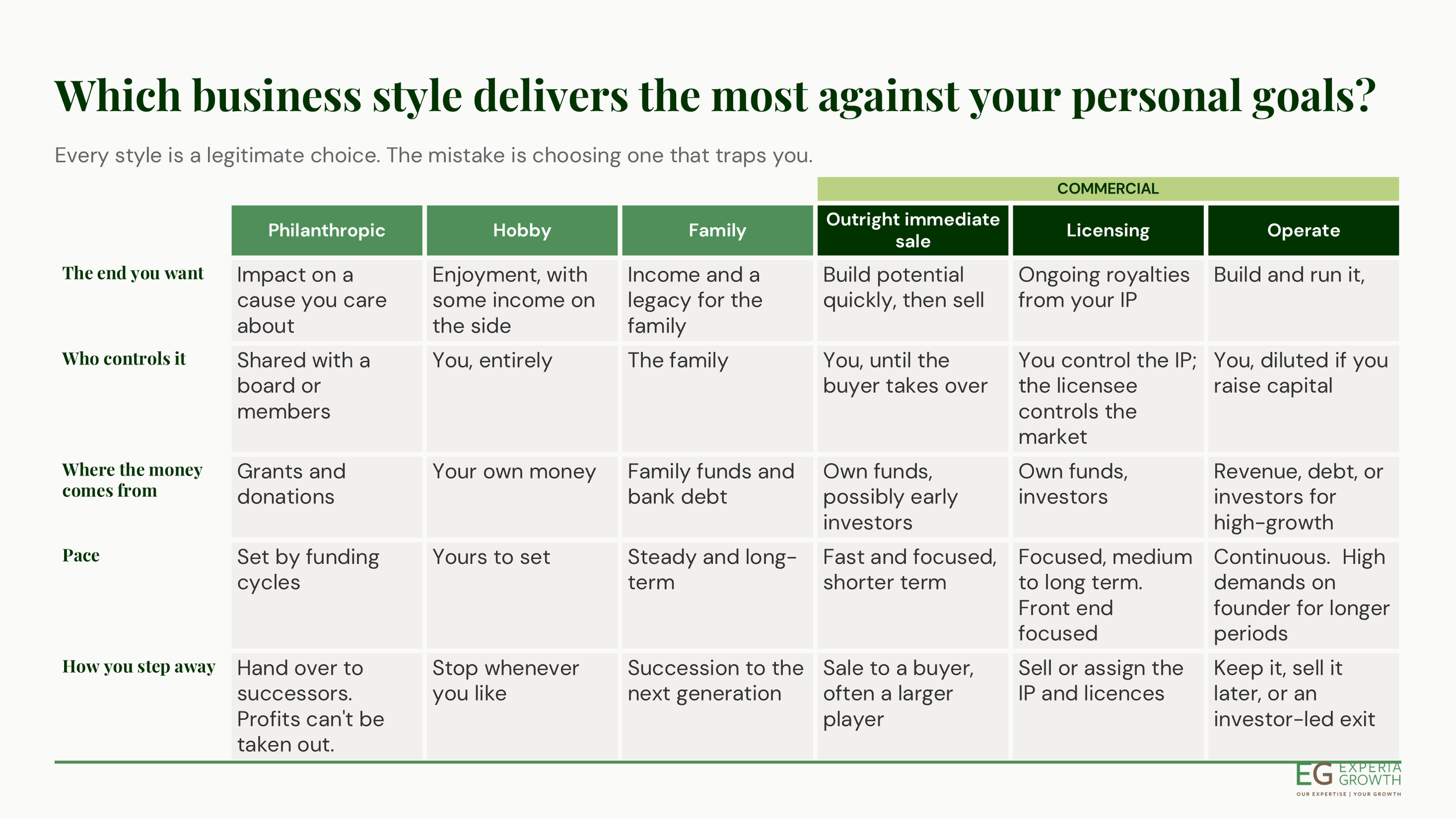
Six different business styles. All valid in themselves, all with VERY different impacts on the Founder.
Examples:
If you’re an introverted technical genius getting the most satisfaction from solving problems - an operating business where you spend most of your time trying to get customers, deal with suppliers and find investors for a single solution isn’t likely to be a great fit.
If your primary goal is the achievement of a social benefit or cause - having to deal with financial return focussed investors is likely to be a challenge that
Key Takeaways:
A business that works can still be the wrong business. Success on terms you didn’t choose is still a trap. Is hating what you do worth it to you?
You ARE going to exit this business. Begin and commercialise with your exit in mind. Each style comes with it’s own exit, so choosing your style basically determines how you’ll leave, except for Commercial operating.
There is no such thing as the BEST business style. There is only the BEST FIT. The fact that everyone else is doing something doesn’t make it the best fit for you.
Plan for the possibility that the business doesn’t work. Understand what you are trying to get, get as much of that as possible, know when to walk away and start the next thing.
A single idea / business is highly unlikely to meet your long term personal goals. Don’t put ideas onto a pedestal - you end up holding on too long.
That’s it for this article….but if you want tips on how to determine your goal - check here.
Until next time!