
Pivots prove you’ve wasted your time
Welcome innovators and founders!
Today, we’re going to take a closer look at Pivots - those often celebrated events where startups change tack because, well, they need to in order to grow faster or simply to survive.
Looked at from one perspective pivots are positive. The trigger for the pivot identified a way of saving the startup or a path to improved growth. However, from another perspective, pivots are costly in time and money and raise the question:
Why didn’t you go the pivot path in the first place?
Founders and Innovators are going to learn an enormous number of lessons about their product/tech, how to deliver it effectively and how to attract customers to buy it as their journey continues. These lessons are unavoidable - some will simply confirm what you already knew - some will highlight that you didn’t actually know what you thought you did.
The timing of the learnings is critical. The earlier you learn the lesson, the cheaper (in time and money) it is.
Key lessons to take away:
You can never get your time (or money) back. Founder time is one of the most precious resources a startup has. Wasting it heading down a path that doesn’t work is a long way from ideal.
A lot of Pivots trace back to untested assumptions in the business pillars. Credible businesses balance the three business pillars (product/commercialisation/customer). Assumptions bring down pillars really quickly. Examples include “Everyone I’ve talked to thinks it’s great” - this is not an indicator of customer traction, “It won’t take long to get the bugs/kinks out” - huh, not sure whether this is a time or an achievement assumption but either way not having a reliable product is a problem….etc.
The later the Pivot, the more expensive it is. Conversely, early testing of key assumptions that can kill your business saves time and money in the long run. Duh.
Refusing to pivot can be fatal. Sure, you’ve wasted some time and some money. When the evidence you have says it’s not working, don’t lose it all - pivot quickly, survive and learn.
Pivots aren’t bad. They’re often necessary to survive. We know because in the first month after creating Experia 18 months ago, we pivoted. We made an assumption regarding the WA startup ecosystem (specifically that it had the same characteristics as the ecosystems over east) which was catastrophically wrong. So we rebuilt Experia after just one month.
Key Actions :
Understand the three key business pillars. These are a) Product/Technology b) Commercialisation (delivery) c) Customers. If you only address one, well that’s not a credible business.
Test your critical assumptions in EACH pillar. No, not all assumptions are critical. Just test the ones that will kill your startup if it’s wrong. Genuine customer traction, compliance with required legislation, cost of technology (time), freedom to operate are all examples of critical assumptions.
Listen honestly to what your testing is telling you! It may not be what you want to hear. It may be waaay better than you expected (which can be an issue in itself). Whatever the result is - don’t ignore it, don’t reinterpret it to support your view.
Remember - Test Early. The market is going to teach you lessons as you progress anyway. Get the big lessons out of the way.
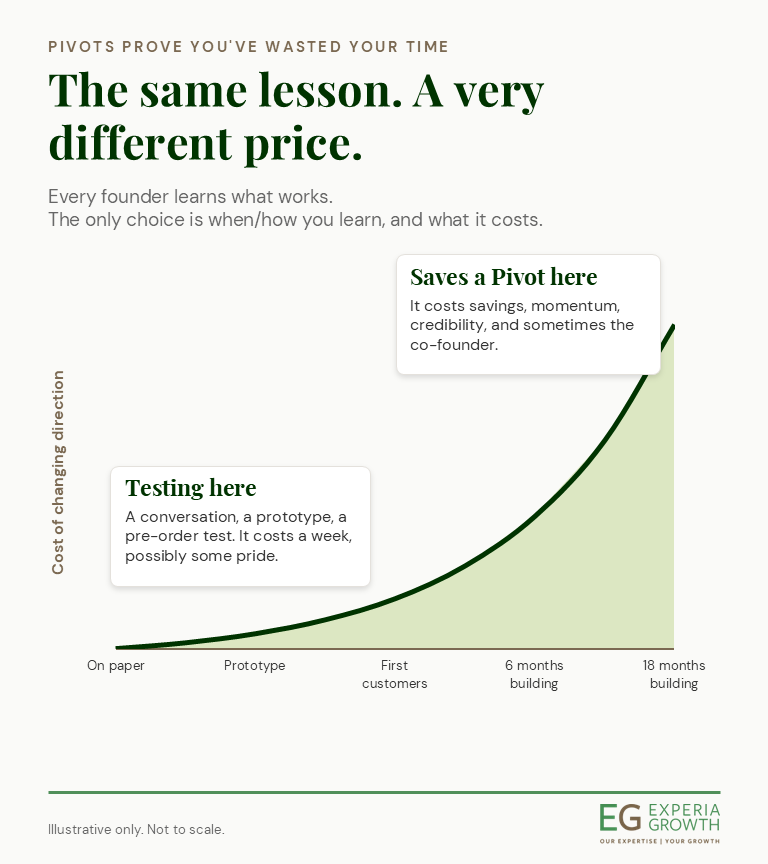
Chart showing how testing early saves significant pivot costs later.
Let’s wrap this up. Creating a startup business isn’t easy. Failure rates are high. Listening to the market and responding with a pivot may be the only way to save your startup. Pivots are in no way “bad”.
However, most pivots can usually be traced back to a critical assumption that wasn’t properly tested, or a lack of focus on one (or two!) of the credible business pillars. Now you can kid yourself that “you’ll build it and they’ll come”, or you can assume it, same diff. But when they don’t and you have to pivot down the track - well, hindsight is perfect.
That’s all for now, reach out if you have questions!